By Dr Kaushal Yadav, MS, MCh (Surgical Oncology, Tata Memorial Hospital, Mumbai) · Director, Surgical Oncology, Max Hospital, Gurgaon (Gurugram) · Updated 20 November 2026 · Educational information, not medical advice.
You finish a small meal. Ten minutes later your head spins, your heart races and a cold sweat breaks out. If you or someone at home has had surgery for stomach or food pipe cancer, this can feel frightening. It does not mean you are doing something wrong. It is what happens when food meets a digestive system that has been rebuilt.
The good news is that these problems often ease with a few simple eating habits. This guide to the diet after gastrectomy and esophagectomy explains what changes, why the rules exist, and how to follow them in an everyday Indian kitchen.
In short
- Eat 6 to 8 small meals a day, by the clock, even if you don’t feel hungry.
- Put protein in every meal. Keep food soft and well cooked at first.
- Keep drinks apart from meals. Sip 30 minutes before or after eating.
- Go easy on added sugar as a daily habit, to lower the chance of dumping syndrome. For sudden weakness from low blood sugar, a small amount of glucose or something sweet is fine.
- Sit upright for 30 to 60 minutes after eating, and raise the head end of your bed.
- Take vitamins and have blood tests as your team advises.
- Your own surgeon and dietitian set the exact plan.
What changes in your body after stomach or food pipe surgery?
Your stomach does three jobs. It stores food, grinds it with acid and enzymes, and releases it slowly into the intestine. It also helps send the “I’m hungry” signal. Surgery changes one or more of these jobs. For background on the disease itself, see our page on stomach cancer.
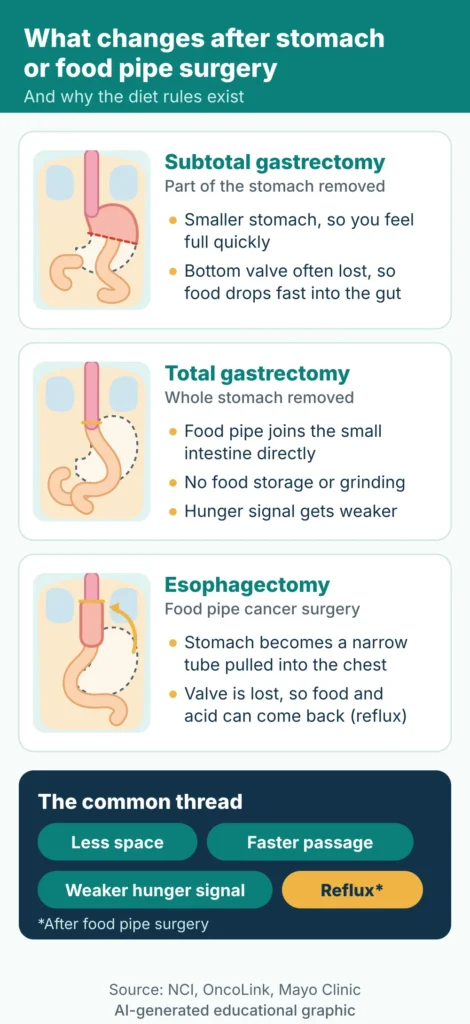
- Subtotal (partial) gastrectomy: Part of the stomach is removed. What remains is smaller, so you feel full quickly. In many cases the valve at the bottom of the stomach is lost too, so food can drop into the intestine faster than normal.
- Total gastrectomy: The whole stomach is removed and the food pipe is joined directly to the small intestine. There is no storage space and no grinding. The hunger signal also becomes weaker.
- Esophagectomy (food pipe cancer surgery): The diseased food pipe is removed. The stomach is shaped into a narrow tube and pulled up into the chest to replace it, often called a gastric pull-up. The valve that normally keeps acid down is lost, so food and acid can come back up (reflux).
The operations differ, but the problems are the same: less space, faster passage, a weaker hunger signal and, after food pipe surgery, reflux. Almost every diet rule below comes from one of these four. After food pipe surgery the change is permanent, so nutrition needs attention in the long term too.
What is dumping syndrome?
Dumping syndrome happens when food or liquid moves too fast from the stomach, or the new stomach tube, into the small intestine. It can follow both gastrectomy and esophagectomy. It comes in two forms.
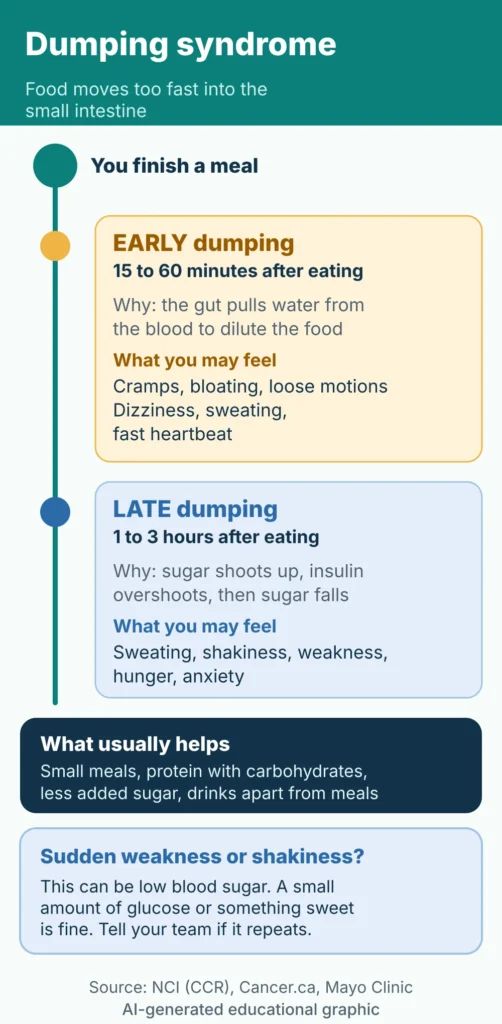
- Early dumping (15 to 60 minutes after eating): The intestine pulls water from the blood to dilute the sudden load of food, especially sugar. You may feel cramps, bloating, loose motions, dizziness, sweating and a racing heartbeat.
- Late dumping (1 to 3 hours after eating): Sugar is absorbed quickly, the body releases too much insulin, and blood sugar then falls. You may feel sweaty, shaky, weak, hungry or anxious.
Late dumping is a drop in blood sugar. If you feel sudden weakness, shakiness, sweating or hunger, a small amount of glucose or something sweet is fine. Tell your care team if this keeps happening.
Some people have both. Dumping can also appear months or even years after surgery. Diet changes are the first step in managing it, as an international expert consensus also advises. If symptoms keep coming back despite these changes, tell your surgical team, because further options exist.
Six simple eating rules (and the reason behind each)
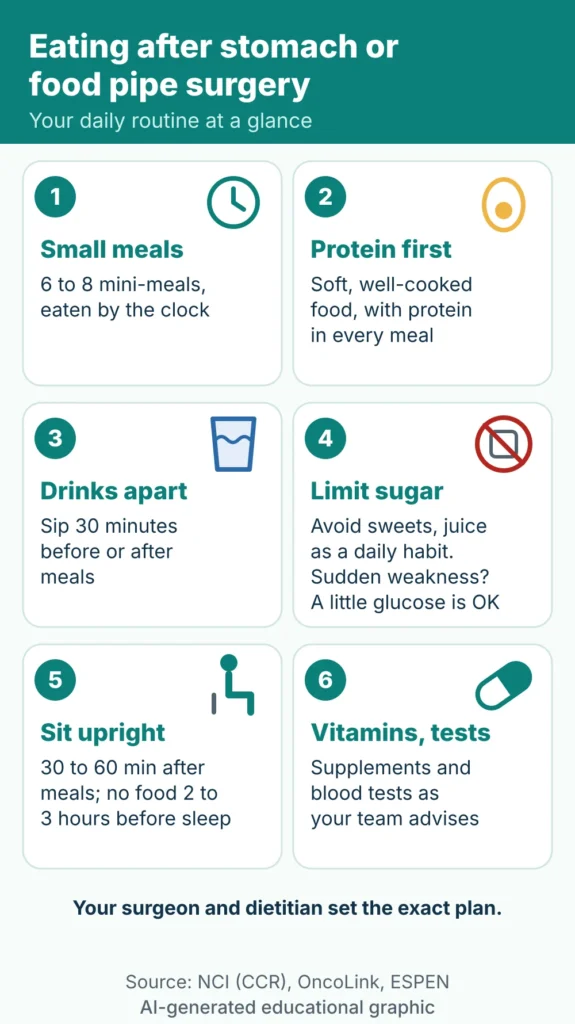
1. Eat small meals, often, by the clock
- Aim for 6 to 8 small meals or snacks a day instead of three big meals.
- Eat on a schedule even when you aren’t hungry. After surgery, especially total gastrectomy, the hunger signal is not reliable.
- Weakness, tiredness, dizziness, or nausea more than two hours after your last meal can be your body asking for food.
- Eat slowly, chew well and stop when you feel full.
- Portions usually grow slowly over several months.
Why: The new stomach is small, and big meals reach the intestine too fast.
2. Make food soft, well cooked and protein-rich
- Protein supports healing. Include it in every meal and snack: egg, paneer, unsweetened curd, soft fish or chicken, mashed moong dal khichdi.
- Early on, keep food soft and moist. Tough, stringy meat and soft bread or pav can be hard to swallow after food pipe surgery.
- Dal and other pulses can be heavy at first. Many teams begin with strained moong dal. Ask your dietitian when to move on.
- Add one new food at a time. Everyone tolerates foods differently.
Why: Soft food passes easily, and protein helps you recover when you can only eat small amounts.
3. Keep drinks apart from meals
- Sip fluids between meals, with a gap of about 30 minutes before or after eating. If you need a drink with food, take only small sips.
- Most teams aim for roughly 1.5 to 2 litres of fluid a day unless your doctor sets a different target. Don’t wait until you feel thirsty.
- Skip fizzy drinks and alcohol.
Why: Liquid with food fills the small stomach and pushes food along faster.
4. Go easy on added sugar
- In the early months, avoid sugar, jaggery, mithai, kheer, sweet chai, packaged juice and cold drinks as a daily habit. These are the usual triggers for dumping.
- Pair carbohydrates with protein, for example khichdi with paneer.
- “Sugar-free” is not always gentle. Many sugar-free sweets contain sugar alcohols such as sorbitol, which can cause gas and loose motions in some people. Read labels and ask your dietitian.
- Sudden weakness, shakiness or sweating can mean low blood sugar (late dumping). In that situation a small amount of glucose or something sweet is fine. If you also have diabetes and take insulin or tablets, follow your doctor’s plan for low blood sugar.
Why: Sugar is the fastest trigger for both early and late dumping, so it is kept small and occasional.
5. Sit upright after meals and sleep with your head raised
- Stay upright, sitting or standing, for 30 to 60 minutes after eating. Don’t lie down straight after a meal.
- Avoid food for 2 to 3 hours before sleep.
- Raise the head end of your bed by about 6 inches (15 cm) or more.
- After food pipe surgery, go slow with common reflux triggers: acidic foods (tomato, lemon, tamarind, vinegar, pickles), hot chillies, mint, fizzy drinks, very hot or very cold food, and alcohol.
- Tight clothes and frequent bending can add to reflux. It is also wiser to avoid tobacco.
- During a dumping episode, some people feel better resting with the head slightly raised. Ask your team what suits you.
Why: Gravity helps when the valve that holds food and acid down is gone.
6. Take vitamins and have blood tests as advised
- Without part or all of the stomach, the body absorbs vitamin B12, iron and calcium less well. B12 deficiency is common in the long run after total gastrectomy and can appear months or years later. Low iron is also common after gastrectomy (PubMed).
- Your doctor or dietitian will decide which supplements you need, whether as tablets or injections, and how often to check your blood. Don’t start or stop supplements on your own.
- Keep calcium and iron supplements at least 2 hours apart.
Why: Stomach acid, and a protein the stomach makes called intrinsic factor, are needed to absorb these nutrients.
Is weight loss normal after stomach or food pipe surgery?
Some weight loss is expected. In a large study from a US cancer centre, people who had a total gastrectomy lost more weight over the first year than those who had part of the stomach removed (about 15% versus 6% of body weight in early-stage patients). The biggest change came between 6 and 12 months. Weight then stayed stable or improved by two years.
Some people also lose muscle, which is another reason protein matters. These habits help:
- Protein with every meal.
- Small, frequent meals.
- Weighing yourself once a week and noting the number.
- Regular follow-up with a dietitian.
Some patients need protein drinks or a feeding tube for a period. That is a tool to help you recover, not a failure.
A sample day (example only)
This shows the timing and the types of food. It is not a prescription, and your dietitian will tailor it.
| When | Example |
|---|---|
| 7:30 am | Soft scrambled egg or paneer bhurji |
| 10:00 am | Small bowl of unsweetened curd |
| 12:30 pm | Mashed moong dal khichdi with soft paneer |
| 3:30 pm | Unsweetened protein drink, if your dietitian advises |
| 6:00 pm | Mild fish or chicken stew with mashed vegetables |
| 8:00 pm | Small portion of mashed khichdi |
Sip fluids between meals, not with them. Finish your last meal 2 to 3 hours before you sleep.
When to contact your care team
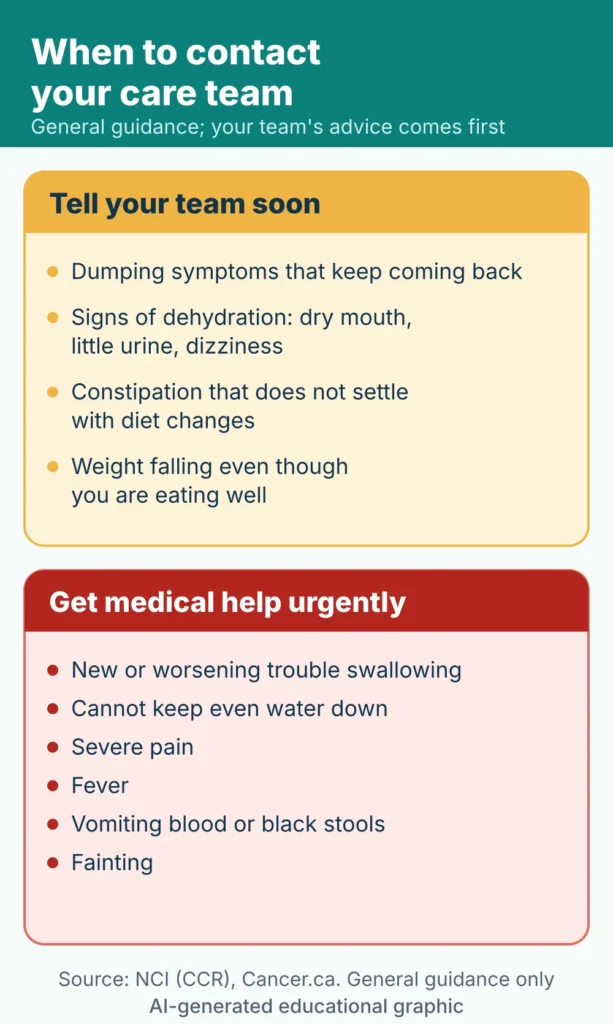
Tell your team soon if you have:
- Dumping symptoms that keep coming back.
- Signs of dehydration: dry mouth, very little urine, dizziness.
- Constipation that doesn’t settle with diet changes.
- Weight falling even though you are eating well.
Get medical help urgently if you have:
- New or worsening trouble swallowing.
- Inability to keep even water down.
- Severe pain.
- Fever.
- Vomiting blood or black stools.
- Fainting.
This is general guidance. Follow the instructions your own team gave you.
Frequently asked questions
What should I eat after stomach cancer surgery?
Soft, well-cooked, protein-rich food in 6 to 8 small meals a day. Examples are egg, paneer, unsweetened curd, soft fish or chicken, and mashed khichdi. Limit added sugar, keep drinks apart from meals, and let your dietitian guide how quickly you move to firmer food.
How many meals a day after gastrectomy?
Most teams advise 6 to 8 small meals or snacks, eaten by the clock rather than by appetite. Hunger signals can be weak after surgery, so waiting until you feel hungry often means eating too little.
Why can't I drink water with meals after gastrectomy?
Liquid fills the small stomach and carries food into the intestine faster, which can cause early fullness or dumping. Leave about 30 minutes before and after meals, and take only small sips if you need a drink with food.
How long does dumping syndrome last?
It varies. Many people find it eases as the body adapts and eating habits change, but it can also appear months or years after surgery. If it keeps happening, tell your surgical team.
What should I avoid after esophagectomy?
Common reflux triggers are acidic foods, hot chillies, mint, fizzy drinks, alcohol, and very hot or very cold food. Tough, stringy meat and soft bread can also be hard to swallow. Each person is different, so add foods one at a time.
Do I need vitamin B12 after gastrectomy?
B12 deficiency is common in the long term after total gastrectomy, and iron and calcium absorption can also fall. Your team will decide which supplements you need, in what form, and when to check your blood levels.
Can I eat sweets or mithai after stomach surgery?
Not as a daily habit. Added sugar is a main trigger for dumping, so it is usually avoided in the early months. For sudden weakness or low blood sugar, a small amount of sweet or glucose is allowed. Ask your dietitian before trying any sweet, including sugar-free ones, which may contain sugar alcohols.
Is weight loss normal after stomach cancer surgery?
Some weight loss is expected, and it is usually greatest between 6 and 12 months after total gastrectomy. Protein, small frequent meals and dietitian follow-up help. Tell your team if weight keeps falling despite eating well.
About the author: Dr Kaushal Yadav is a surgical oncologist (MS, MCh, Tata Memorial Hospital, Mumbai) and Director, Surgical Oncology at Max Hospital, Gurgaon (Gurugram).
Clinic: Arogyam Care Clinic, G-21/22, Ocus Quantum Mall, Sector 51, Gurugram, Haryana 122003. Phone: +91 99111 68762.
This article is for general education only. It does not replace advice from your own surgeon, oncologist or dietitian, who know your operation, your reports and your needs. The cover image and infographics are AI-generated educational graphics.
Related Video
Diet after stomach and food pipe cancer surgery (in Hindi). This educational animation was made with AI assistance (AI-generated visuals) for patient understanding. It is general health education, not personal medical advice. The video advises stopping sweets in the early months. If you have sudden weakness from low blood sugar, a small amount of glucose or something sweet is fine. Your own team sets your plan.
References
- National Cancer Institute, Center for Cancer Research. Diet and Nutrition After Gastrectomy: What You Should Know. ccr.cancer.gov
- OncoLink (Penn Medicine). Post-Esophagectomy Diet. oncolink.org
- van Beek AP, Emous M, Laville M, Tack J. Dumping syndrome after esophageal, gastric or bariatric surgery: pathophysiology, diagnosis, and management. Obes Rev 2017;18(1):68-85. PubMed
- Canadian Cancer Society. Dumping syndrome. cancer.ca
- Mayo Clinic. Dumping syndrome. mayoclinic.org
- Weimann A, et al. ESPEN guideline on clinical nutrition in surgery, Update 2025. Clin Nutr 2025;53:222-261. PubMed
- Davis JL, Selby LV, Chou JF, et al. Patterns and predictors of weight loss after gastrectomy for cancer. Ann Surg Oncol 2016;23(5):1639-1645. PubMed
- Kim HI, Hyung WJ, Song KJ, et al. Oral vitamin B12 replacement: an effective treatment for vitamin B12 deficiency after total gastrectomy in gastric cancer patients. Ann Surg Oncol 2011;18(13):3711-3717. PubMed · DOI
- Scarpellini E, Arts J, Karamanolis G, et al. International consensus on the diagnosis and management of dumping syndrome. Nat Rev Endocrinol 2020;16(8):448-466. PubMed · DOI
- Davis JL, Ripley RT. Postgastrectomy syndromes and nutritional considerations following gastric surgery. Surg Clin North Am 2017;97(2):277-293. PubMed · DOI
- Steenhagen E, van Vulpen JK, van Hillegersberg R, May AM, Siersema PD. Nutrition in peri-operative esophageal cancer management. Expert Rev Gastroenterol Hepatol 2017;11(7):663-672. PubMed · DOI
- Triantafillidis JK, Papakontantinou J, Antonakis P, Konstadoulakis MM, Papalois AE. Enteral nutrition in operated-on gastric cancer patients: an update. Nutrients 2024;16(11):1639. PubMed · DOI
Discover more from CancerSurgery
Subscribe to get the latest posts sent to your email.