By Dr Kaushal Yadav, MS, MCh (Surgical Oncology), Director, Surgical Oncology, Max Hospital, Gurgaon · Practising in Gurgaon (Gurugram), Haryana · Last reviewed: 3 November 2026 · Educational information, not medical advice.
Short answer
For most people, hair starts to grow back a few months after chemotherapy ends. It often comes back fine and soft, and it may look different from before. For some people, regrowth stays thin or patchy beyond six months. How often this happens depends on the drugs used, and it is worth discussing with your doctor.
Key points
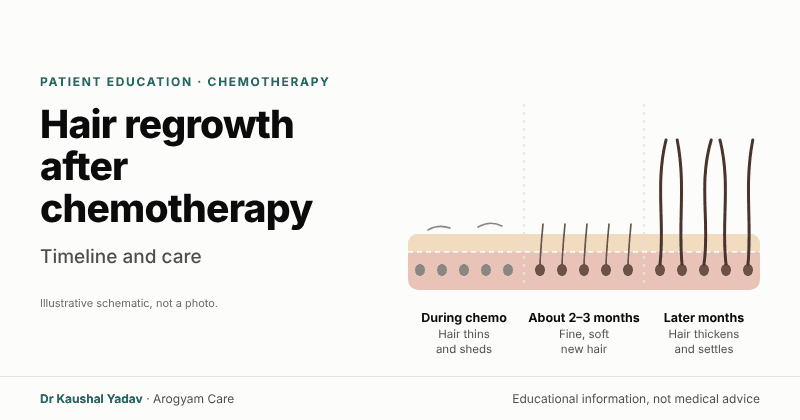
- Hair often starts growing back about 2 to 3 months after chemotherapy ends. The timing varies.
- New hair can be curlier, straighter or a different colour. It often settles over time.
- Thin or patchy hair beyond 6 months has a name, persistent chemotherapy-induced alopecia, and a doctor can help.
- Gentle care helps. No food, oil or supplement has been shown to speed up regrowth.
- Cold caps may reduce hair loss, but they must be planned before treatment starts.
Why does chemotherapy cause hair loss?
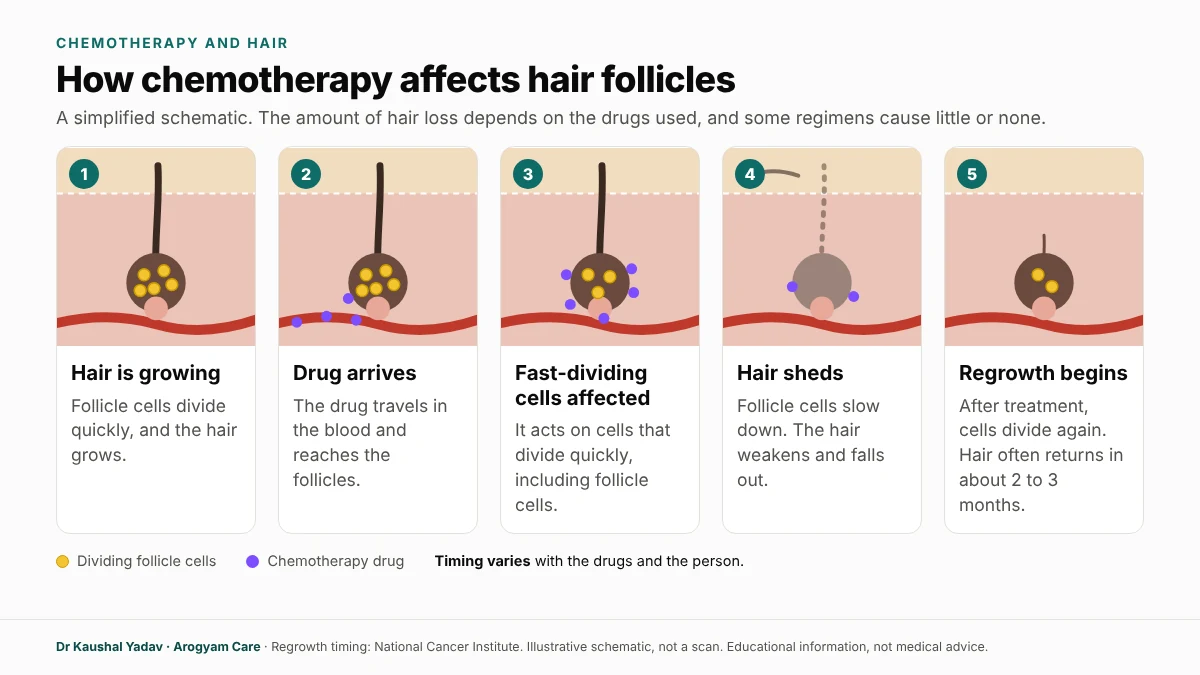
Chemotherapy targets cells that divide quickly, which is how it attacks cancer. Hair root cells also divide quickly, so they are affected too. A commonly quoted figure is that about 65% of people lose hair. The real risk depends on the drugs. Some regimens cause little or no hair loss, while combinations with anthracyclines or taxanes are the most likely to cause heavy loss.
When does hair grow back?
| When | What you may notice |
|---|---|
| About 2 to 3 months after the last session | Fine, soft hair begins to appear |
| The next few months | Hair thickens. It may be curly, straighter or a different colour (“chemo curls”) |
| Later | Many people see their hair slowly return toward its earlier look |
| 6 months, still thin or patchy | See your oncologist or a dermatologist |
Will it always grow back fully?
Most people see regrowth, but not everyone gets their full hair back. Hair loss continuing beyond six months after chemotherapy ends is called persistent chemotherapy-induced alopecia. Studies report very different rates, from about 1 in 100 to more than 4 in 10 people, because drugs and definitions differ. It is reported more often with taxanes (such as docetaxel and paclitaxel), anthracyclines and a few other drugs.
If regrowth is thin at six months, a doctor can look for the cause and discuss options. A 2025 international expert panel recommended early treatment with minoxidil, applied to the scalp or taken as low-dose tablets, for selected people. It must be prescribed and supervised by a doctor.
What you can do while hair grows back
Be gentle
- Use a mild shampoo, wash less often, and pat dry with a soft towel.
- Use a soft brush or wide-tooth comb, and avoid hard brushing.
- Go easy on hair dryers, straighteners and curlers.
- Protect your scalp from the sun with a soft hat, scarf or sunscreen.
- Ask your oncology team before colouring, bleaching or straightening. New hair is delicate.
- Ask your oncologist before using any eyelash or eyebrow product. Lashes and brows can thin too.
Support your body
- Eat regular balanced meals with protein: dal, eggs, paneer, curd, fish, chicken or soy. Your oncologist or dietitian can tell you how much you need.
- Sleep, short walks and stress relief help recovery. No study shows they speed up hair growth.
- No vitamin, mineral or oil has been proven to speed up regrowth after chemo. Ask your doctor before taking supplements. Biotin, often found in supplements, can interfere with some lab tests and cause incorrect results. If you are worried about vitamin D, ask for a blood test rather than guessing.
- Scalp massage and oils are fine if they feel comfortable. They have not been shown to speed up regrowth. Be wary of “guaranteed regrowth” products.
Minoxidil does not stop hair falling out during chemotherapy. In a small trial of 22 women, the period of baldness was about 50 days shorter on average. A 2026 review called the evidence limited. Use it only if your oncologist or dermatologist advises it.
Cold caps (scalp cooling)
A cold cap cools the scalp before, during and after each chemotherapy session. The cold narrows the scalp’s blood vessels, so less drug reaches the hair roots. In a US trial of women with early breast cancer, about 1 in 2 who used scalp cooling lost less than half of their hair. None of the women who did not use it kept that much.
What to know:
- It works better with some drugs than others, and it does not suit everyone. It is usually avoided in blood cancers such as leukaemia and lymphoma.
- It can feel uncomfortable (cold, headache), and it has to be planned from the first session.
- A growing number of hospitals in India now offer scalp cooling. It is not available everywhere, so ask your team before your first cycle.
It is normal to feel upset
Hair loss is consistently ranked among the most troublesome side effects of chemotherapy, and it can change how you feel about yourself. Tell your care team how you feel. Ask about counselling and practical help such as wigs, scarves or caps.
When to see a doctor
- Hair is thin or patchy, or has not started growing back, 6 months after chemotherapy ends.
- Your scalp is painful, red or sore.
- The hair changes are affecting your mood or daily life.
Frequently asked questions
When will my hair start to grow back after chemotherapy?
Often about 2 to 3 months after treatment ends. The timing varies with the drugs and the person.
Will my hair grow back the same?
It often returns toward its earlier look over time. At first it may be finer, curlier, straighter or a different colour.
Is chemotherapy hair loss permanent?
Most people see hair return, but some are left with thin or patchy regrowth beyond six months. Rates vary widely by drug. A doctor can assess it and discuss options.
How can I make my hair grow faster after chemo?
There is no proven shortcut. Gentle hair care, balanced meals and sun protection help. Ask your doctor about medicines such as minoxidil.
Do cold caps work for everyone?
No. They work better with some drugs, are usually avoided in blood cancers, and must be started with the first session.
Can I colour or straighten my hair after chemo?
Ask your oncology team first. New hair is fragile, and heat and chemicals can damage it.
When should I see a doctor about hair regrowth?
If hair is thin, patchy or absent at six months, or if your scalp is painful or sore.
Summary
Hair usually starts to return a few months after chemotherapy, but timing and quality vary. Gentle care helps, and no product has been proven to speed regrowth. If hair is still thin at six months, see your doctor. Cold caps, if suitable, are decided before the first session.
Dr Kaushal Yadav consults at Arogyam Care Clinic, G-21/22 Ocus Quantum Mall, Sector 51, Gurugram, Haryana 122003. Phone: 9911168762.
This article is for education only and is not a substitute for medical advice. Discuss your own treatment with your doctor.
Related Video
Dr Kaushal Yadav explains hair regrowth after chemotherapy (in Hindi). The video is general health education and not personal medical advice. Please discuss your own treatment with your doctor.
References
- National Cancer Institute. Side effects: hair loss. cancer.gov
- Freites-Martinez A, et al. Expert consensus for prevention, diagnosis and management of persistent chemotherapy-induced alopecia. J Eur Acad Dermatol Venereol 2025;39:2039–2046. DOI
- Garza-Rodríguez V, et al. Persistent chemotherapy-induced alopecia: updates in diagnosis and treatment. Actas Dermosifiliogr 2026. DOI
- Gaumond SI, et al. Chemotherapy-induced alopecia in breast cancer patients: treatment-specific incidence and risk of persistent hair loss. Cancers 2026;18:861. DOI
- Nangia J, et al. Effect of a scalp cooling device on alopecia in women undergoing chemotherapy for breast cancer: the SCALP randomized clinical trial. JAMA 2017;317:596–605. DOI
- Duvic M, et al. A randomized trial of minoxidil in chemotherapy-induced alopecia. J Am Acad Dermatol 1996. DOI
- Iimura Y, et al. Minoxidil and prostaglandin analogs for chemotherapy-induced alopecia: a scoping review. Curr Oncol Rep 2026. DOI
- Lemieux J, et al. Chemotherapy-induced alopecia and effects on quality of life among women with breast cancer: a literature review. Psychooncology 2008;17:317–328. DOI
- US FDA. UPDATE: The FDA warns that biotin may interfere with lab tests (safety communication, November 2019). fda.gov
Discover more from CancerSurgery
Subscribe to get the latest posts sent to your email.