By Dr Kaushal Yadav, MS, MCh (Surgical Oncology), Director, Surgical Oncology, Max Hospital, Gurgaon · Practising in Gurgaon (Gurugram), Haryana · Last reviewed: 2 November 2026 · Educational information, not medical advice.
Short answer
A report that says “ovarian cyst” does not mean cancer. Most ovarian cysts are benign, and many are simple fluid-filled sacs that resolve on their own or only need follow-up scans. Doctors judge risk mainly from the cyst’s structure on ultrasound, then its size and growth, symptoms, and the woman’s age and menopausal status. Blood tests help, but none gives the answer alone.
Key points
- A simple cyst (thin wall, only fluid, no solid parts) is very rarely cancer.
- Structure matters more than size: a complex cyst with solid areas needs closer assessment even when small.
- Persistent bloating, early fullness, pelvic pain or urinary urgency need a medical check, though they do not mean cancer.
- CA-125 can rise without cancer and can be normal with cancer; HE4 and the ROMA score add information but are not diagnostic.
- Sudden severe one-sided pain with vomiting or fainting needs emergency assessment.
What is an ovarian cyst?
An ovarian cyst is a fluid-filled sac in or on an ovary. Most form during the monthly cycle, when a follicle does not release or reseal normally; these are called functional cysts. Small simple cysts under 5 cm almost always resolve within about three menstrual cycles (RCOG). For a gynaecology overview of cyst types, causes and treatment, see Ovarian cysts: causes, symptoms and treatment on GyneLap (Dr Kiran Yadav, gynaecologist).
Is an ovarian cyst the same as ovarian cancer?
No. A cyst is a finding on a scan. Ovarian cancer is a diagnosis made on tissue examination after surgery or biopsy. The two can look different on ultrasound. For an overview of the cancer itself, see the ovarian cancer page.
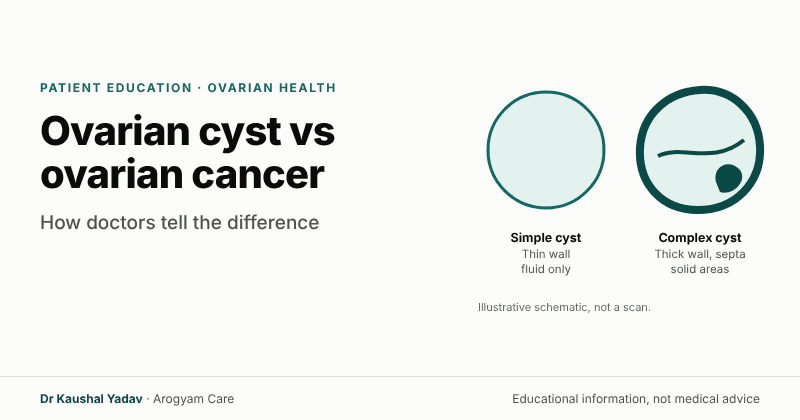
| Feature | Typical simple cyst | Features that raise concern |
|---|---|---|
| Wall | Thin, smooth | Thick or irregular |
| Inside | Fluid only | Solid areas, papillary projections, thick septations |
| Blood flow (Doppler) | None inside | Strong flow in solid parts |
| Behaviour over time | Shrinks or stays stable | Grows, persists |
| O-RADS category | 2 (almost certainly benign, under 1% risk) | 3 to 5 (low to high risk) |
The four signals doctors weigh
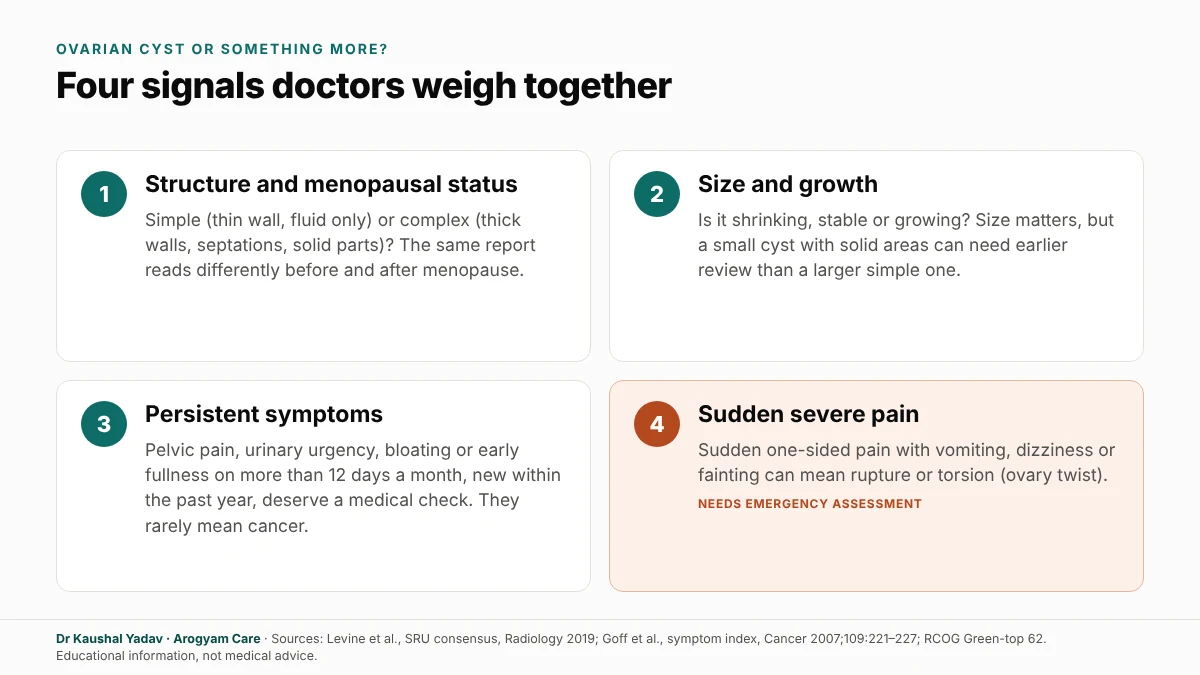
1. Structure, age and menopausal status. The most useful question is whether the cyst is “simple”: a smooth-walled fluid collection with no solid or vascular parts. SRU consensus found an exceptionally low cancer risk with simple adnexal cysts. A “complex” cyst has thick walls, septations or solid components and is assessed more closely, whatever its size. The same report can mean different things before and after menopause. Simple cysts are less worrying in women who still have periods, and doctors look harder after menopause.
2. Size and growth. Size matters, but it does not decide the outcome on its own. A 7 cm simple cyst may need only follow-up scans, while a 3 cm cyst with solid areas may need earlier specialist evaluation. Doctors also look at whether the cyst is shrinking, stable or growing. A cyst that shrinks by 10–15% or more needs no further follow-up (SRU).
3. Persistent symptoms. Most cysts cause no symptoms. When symptoms are present they are usually mild, such as bloating, early fullness, a pressure or pain in the lower abdomen, or needing to pass urine more often. The published symptom index flags pelvic or abdominal pain, urinary urgency or frequency, bloating or increased abdominal size, and difficulty eating or feeling full when they occur more than 12 days a month and began within the past year. These symptoms are common and rarely mean cancer, but if they persist they deserve a medical evaluation rather than being put down to gas.
4. Sudden severe symptoms. Sudden severe pain on one side with dizziness, vomiting or fainting can mean a cyst has ruptured or the ovary has twisted (torsion). Torsion needs emergency treatment, because delay can damage the ovary. In women who could be pregnant, doctors also rule out ectopic pregnancy with a pregnancy test.
What size of ovarian cyst is a concern?
Size thresholds apply to simple cysts with no symptoms in women at average risk, seen on a good-quality ultrasound. They do not apply to complex cysts, pregnancy, or women at high genetic risk.
| Guideline | Observation | Further assessment |
|---|---|---|
| RCOG Green-top 62 (before menopause) | Under 5 cm: usually no follow-up. 5–7 cm: yearly ultrasound. | Over 7 cm: consider MRI or surgery. |
| SRU 2019 | Before menopause: follow-up imaging only above 5–7 cm. After menopause: above 3–5 cm. | RCOG cites SRU as advising MRI or surgical evaluation above 7 cm. |
| O-RADS US v2022 | Simple cyst under 10 cm: category 2, almost certainly benign. | Unilocular cyst of 10 cm or more: category 3 (low risk, 1 to under 10%); expert ultrasound or MRI advised. |
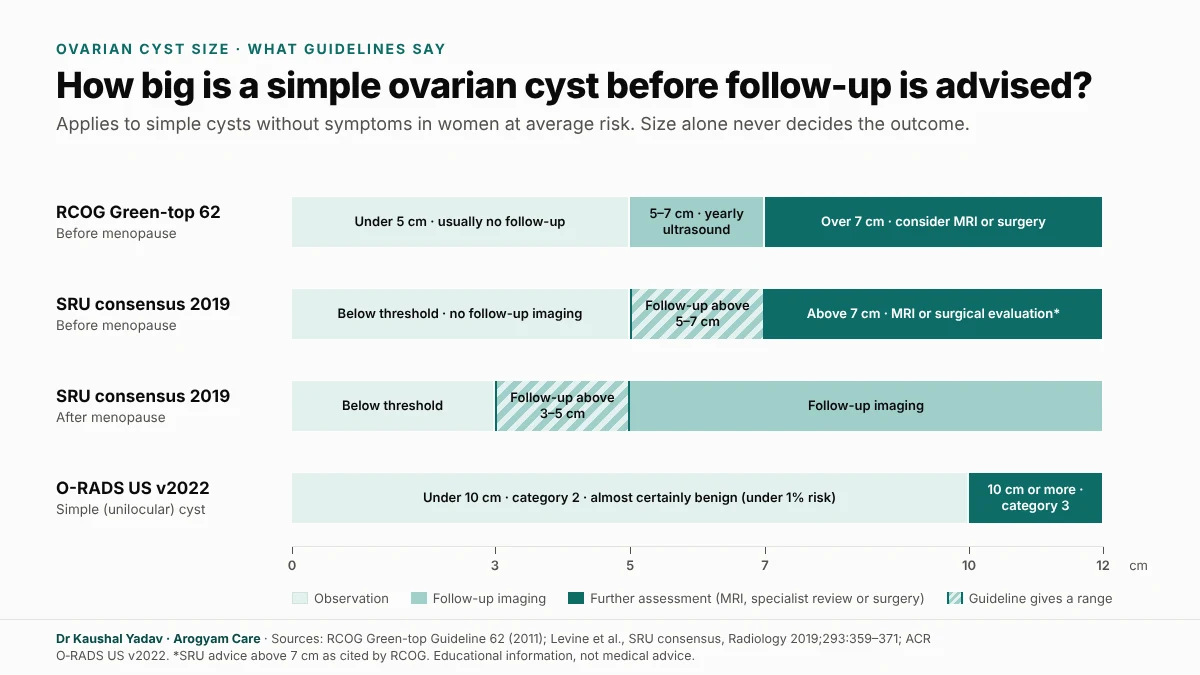
A 2023 review adds that cysts larger than 10 cm, or with solid components or strong Doppler flow, are higher-risk. The RCOG notes there is no evidence-based consensus on the size at which surgery should be considered, so the decision is individual.
Can CA-125, HE4 and ROMA tell a cyst from cancer?
CA-125 is a blood marker that is often raised in ovarian cancer, but it also rises in non-cancer conditions such as endometriosis. In 391 premenopausal women with benign pelvic masses, CA-125 was raised in 37.1% but HE4 in only 2.3%. CA-125 can also be normal in early cancer. It is never used alone.
HE4 is a second marker. It is more specific than CA-125 but misses more cancers, and it is raised in chronic kidney disease (median 193 pmol/L in kidney patients against 90.8 in ovarian cancer in one study).
ROMA combines CA-125, HE4 and menopausal status into one risk score. Pooled results from a 2021 meta-analysis of women with a pelvic mass:
| Sensitivity | Specificity | |
|---|---|---|
| CA-125 | 0.84 | 0.73 |
| HE4 | 0.73 | 0.90 |
| ROMA, after menopause | 0.88 | 0.83 |
| ROMA, before menopause | 0.80 | 0.80 |
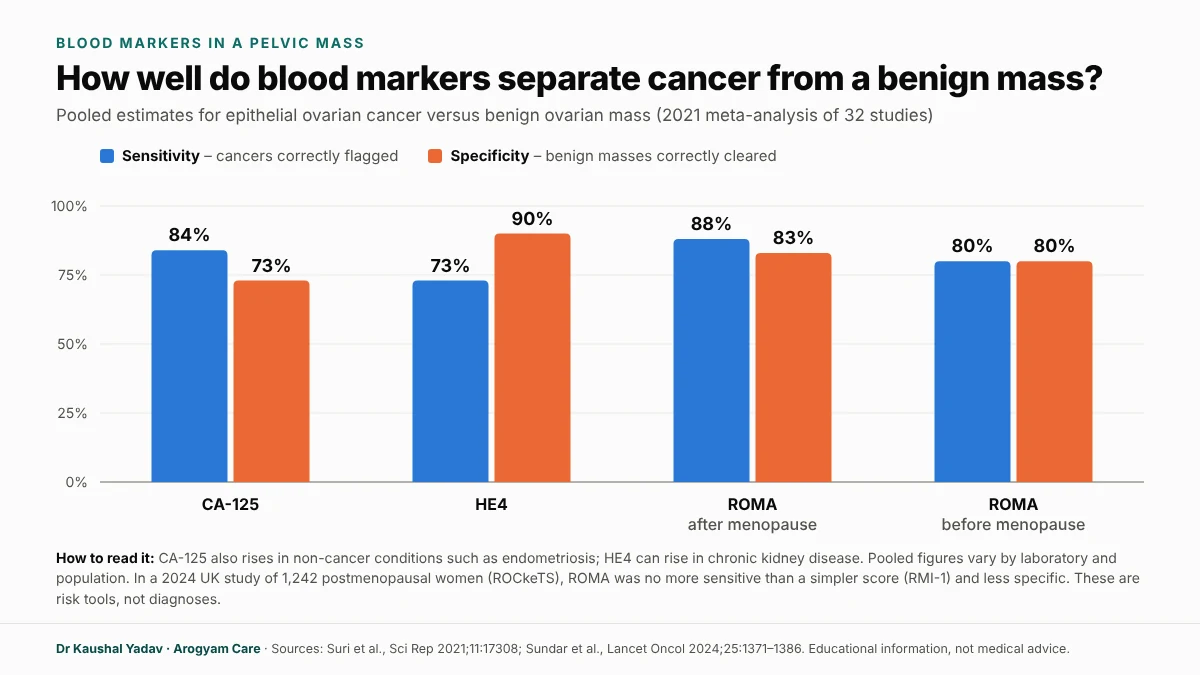
These are pooled figures, and individual results vary by laboratory and population. In a 2024 UK study of 1,242 postmenopausal women, ROMA was no more sensitive than a simpler score (RMI-1) and less specific, and an ultrasound-based model (IOTA ADNEX) was recommended as the new standard. ROMA is a risk tool, not a diagnosis.
How doctors work it out
- Transvaginal ultrasound comes first and is the imaging test of choice.
- Blood tests (CA-125, sometimes HE4 or ROMA) are interpreted with the scan, age and menopausal status.
- MRI is used when ultrasound is uncertain; it improves specificity.
- Specialist referral to a gynaecologic oncologist follows when features suggest cancer.
When is surgery considered?
Most simple cysts are watched, not removed. Surgery is considered when a cyst is complex or suspicious, growing or persistent, causing symptoms that affect daily life, complicated by torsion or rupture, or when features are concerning after menopause. The decision combines the scan, an examination and the woman’s own circumstances. Only tissue examination confirms what a cyst is.
Getting an ovarian cyst evaluated in Gurgaon (Gurugram) and Delhi NCR
In Gurgaon and the wider Delhi NCR region, evaluation usually starts with a gynaecologist and a transvaginal ultrasound. If the scan shows complex features, growth or other concerning findings, the next steps are usually an MRI and a review by a gynaecologic or surgical oncologist.
What to bring to a specialist visit:
- the ultrasound report, plus the images or CD if you have them;
- earlier scans for comparison;
- any blood-test reports, such as CA-125 or HE4;
- a dated list of your symptoms;
- the date of your last period, or when your periods stopped;
- any family history of ovarian or breast cancer, or of a known inherited cancer syndrome.
Dr Kaushal Yadav consults at Arogyam Care Clinic, G-21/22 Ocus Quantum Mall, Sector 51, Gurugram, Haryana 122003. Phone: 9911168762.
Frequently asked questions
Can an ovarian cyst turn into cancer?
Simple cysts are not regarded as cancer precursors; SRU found an exceptionally low cancer risk with them. Some cystic tumours are neoplastic from the start, which is why complex features matter more than the word “cyst”.
What size ovarian cyst is dangerous?
No single size defines danger. For simple cysts, guidelines allow observation up to about 7 cm (RCOG, SRU) or under 10 cm (O-RADS). Complex features, growth and symptoms matter as much as size.
Does a normal CA-125 rule out ovarian cancer?
No. CA-125 can be normal in early disease. It is read together with the ultrasound, age and menopausal status.
Does a high CA-125 mean I have cancer?
No. It also rises in endometriosis and other non-cancer conditions, so it prompts further assessment and nothing more.
What is a ROMA score?
ROMA (Risk of Ovarian Malignancy Algorithm) combines CA-125, HE4 and menopausal status into a risk estimate. It helps decide who needs specialist assessment and is not a diagnosis.
Is HE4 better than CA-125?
HE4 is more specific but less sensitive, and kidney disease can raise it. The two are usually read together.
Do bloating and feeling full mean cancer?
Usually not. They are common and have many causes, but persistent symptoms (over 12 days a month, new within the past year) should be checked. The index misses some cancers and flags some women who do not have cancer.
Is a cyst after menopause more worrying?
Doctors assess it more carefully after menopause, and follow-up thresholds are lower (SRU: above 3–5 cm). Many simple cysts after menopause are still benign.
Is sudden ovarian cyst pain an emergency?
Sudden severe one-sided pain with vomiting or fainting can signal rupture or torsion and needs emergency medical assessment.
Which doctor should I see for an ovarian cyst in Gurgaon?
Start with a gynaecologist, who will arrange a transvaginal ultrasound. If the cyst looks complex or suspicious, referral to a gynaecologic or surgical oncologist is the usual next step. Dr Kaushal Yadav is a surgical oncologist practising in Gurgaon (Gurugram); contact details are given above.
Which tests are used to check an ovarian cyst in Delhi NCR?
The usual sequence is a transvaginal ultrasound, then blood markers such as CA-125, sometimes HE4 or a ROMA score, and MRI if the scan is uncertain. Ask the laboratory whether it offers HE4 and ROMA.
Summary
An ovarian cyst is a scan finding that is usually benign. Structure, size and growth, persistent symptoms and menopausal status guide the next step, and CA-125, HE4 and ROMA add information without settling it. Any decision about follow-up or surgery should be made with your own doctor.
Dr Kaushal Yadav consults at Arogyam Care Clinic, G-21/22 Ocus Quantum Mall, Sector 51, Gurugram, Haryana 122003. Phone: 9911168762.
This article is for education only and is not a substitute for medical advice. Discuss your own report with your doctor.
Related reading
Related Video
Dr Kaushal Yadav explains this topic in the video below. The video is general health education and not personal medical advice. Please discuss your own report with your doctor.
References
- Levine D, et al. Simple adnexal cysts: SRU consensus conference update on follow-up and reporting. Radiology 2019;293:359–371. DOI
- American College of Radiology O-RADS US Committee. O-RADS US v2022: an update. Radiology 2023. DOI
- RCOG Green-top Guideline No. 62. Management of suspected ovarian masses in premenopausal women. 2011. PDF
- Stein EB, et al. Contemporary guidelines for adnexal mass imaging: a 2020 update. Abdom Radiol 2020;46:2127–2139. DOI
- Wheeler V, et al. Adnexal masses: diagnosis and management. Am Fam Physician 2023;108:580–587. PubMed
- Goff BA, et al. Development of an ovarian cancer symptom index. Cancer 2007;109:221–227. DOI
- Shetty J, et al. Modified Goff Symptom Index: simple triage tool for ovarian malignancy (Indian population). SQU Med J 2015;15:e370–375. DOI
- Suri A, et al. Diagnostic measures comparison for ovarian malignancy risk in epithelial ovarian cancer patients: a meta-analysis. Sci Rep 2021;11:17308. DOI
- Sundar S, et al. Risk-prediction models in postmenopausal patients with symptoms of suspected ovarian cancer in the UK (ROCkeTS). Lancet Oncol 2024;25:1371–1386. DOI
- Huang X, et al. Comparison between serum HE4 and CA125 as tumor markers in premenopausal women with benign pelvic mass. Clin Lab 2019;65. DOI
- Yan S, et al. Significantly elevated serum HE4 in chronic kidney disease patients without ovarian cancer. J Clin Lab Anal 2023;37:e24847. DOI
Discover more from CancerSurgery
Subscribe to get the latest posts sent to your email.