By Dr. Kaushal Yadav, MS, MCh (Surgical Oncology), Director, Surgical Oncology, Max Hospital, Gurgaon · Last reviewed 23 October 2026 · Education only
After breast cancer surgery, many people hear a long list of “don’ts”: don’t move the arm, don’t lift more than 2 kg, your arm will swell. Some of this advice is useful. Some of it is stricter than the evidence supports.
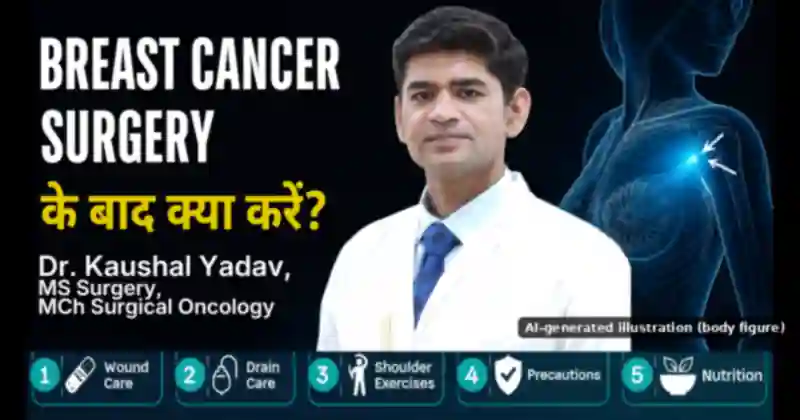
This article follows our video Post Breast Surgery Care. It covers wound care, the drain, shoulder exercises, arm precautions and food. For each part it says how strong the evidence is. Your own surgical team’s instructions always come first.
Key points
- Arm care means precautions, not prohibitions: protect the arm, but keep it moving.
- Wound and drain care follow your surgeon’s discharge instructions. Practice differs between operations and surgeons.
- Gentle shoulder exercises improve movement, and trials have not shown that they raise the risk of arm swelling (lymphedema, also spelled lymphoedema). When to start is your surgeon’s call.
- Most arm precautions are sensible but rest on limited evidence. They may lower the chance of lymphedema. They do not guarantee anything.
- Eat a balanced diet. Ask your surgical oncologist before any supplement, kadha or herbal medicine.
Who this applies to
This applies after mastectomy or breast-conserving surgery, especially when lymph nodes from the armpit were removed. Removing these nodes can disturb the arm’s lymph drainage, which is why arm-care advice exists. Some care applies to every patient. Other details depend on your operation, so follow your discharge sheet.
1. Wound care
- Bathing: Many teams allow bathing, including with stitches in place. This depends on your dressing and your surgeon, so ask first.
- After the bath: Pat the wound dry with a clean cotton towel. Do not rub.
- Antiseptic cream: If your surgeon advises it, a thin layer goes along the stitch line. Dressing practice varies.
- What not to apply: Do not put turmeric, powder, oil or other home remedies on the wound. They can irritate the skin and make it harder for your team to judge healing.
- After reconstruction: Surgeons often advise a sports bra.
- Clothing: Keep clothing near the armpit loose.
- Numbness: Numbness in the inner arm and the side of the chest is common. It often improves slowly over time, though some people keep a small patch of numbness.
2. Drain care
A drain is a thin tube with a bottle, often placed during surgery to remove fluid that collects in the area.
- Keep the bottle below the level of the incision. Carry it in a small cloth bag so the tube is not pulled.
- Keep the bottle squeezed so it keeps suction.
- Keep a drain log. Note the millilitres at a fixed time each day. Your surgeon decides when to remove the drain.
- Do not pull the drain yourself. Do not flush it with a syringe or put anything into the tube.
- Tell your team if the drain is blocked, leaking near the tube, the bottle is swollen, or the drain has come out.
One review of armpit (axillary) surgery, covering 19 studies and 1,962 patients, found fewer clinically significant seromas when the drain stayed until output fell below 50 mL in 24 hours on two days in a row.[6] Policies vary and your surgeon decides.
Seroma is fluid that collects under the scar, often after the drain is removed. It is a common after-effect of breast and armpit surgery.[3] If it becomes uncomfortable or large, your surgeon can drain it.
Warning signs: fever, redness or swelling near the wound, redness in the arm, or swelling in the hand or chest. Contact your surgical team and follow their advice.
3. Shoulder exercises
Shoulder range-of-motion exercises keep the operated side from stiffening. Being able to raise the arm overhead is also needed for positioning in some radiation treatments.
In the video:
- Start about 1–2 days after surgery, where your team agrees.
- Do them 3–4 times a day, with 5–10 repetitions of each exercise.
- Standing or sitting are both fine.
- A mild stretch is acceptable. If pain is severe, stop and tell your physiotherapist or doctor.
- The goal is full shoulder movement in about 4 weeks.
- If you have not started after 2–3 weeks, work with your physiotherapist and doctor.
| Exercise | How |
|---|---|
| Butterfly | Hands behind the head, elbows moving slowly forward and back |
| Wall climbing | Face the wall, walk the fingers up as high as comfortable, then come down slowly |
| Side wall stretch | Stand with the operated side toward the wall and walk the fingers up |
| Back stretch | Hold both hands behind the back and lift them slowly upward |
| Shoulder rotation | Circle the shoulders clockwise, then anticlockwise |
| Arm lift | Join both hands above the head, then raise and lower the elbows |
| Chest wall stretch | Stand in a wall corner, elbows and forearms on the walls, move the chest forward and back |
Mark the wall. A pencil mark helps you reach a little higher each day. Do the exercises only as your team has taught you.
Why the start time is your surgeon’s decision. Trials point in two directions:
- Starting early gives better shoulder movement in the short term. A Cochrane review of 24 trials (2,132 women) found shoulder flexion improved by about 10 degrees with an early start.[2]
- The same review found that early exercise increased wound drainage, both in volume and in about 1 extra day of drainage.[2]
- Another review found that delaying exercise reduced seroma (odds ratio 0.4).[3]
- On lymphedema, a Cochrane review pooled three trials (378 women) comparing an early start with a start about 7 days later. The risk ratio was 1.69 (95% CI 0.94–3.01). That is not statistically significant, but the range is wide, so a small increase cannot be ruled out. The review rated the evidence as low quality.[1]
This is why teams set the timing individually, especially while a drain is in place. The idea that exercise helps lymph flow is plausible, but it has not been proven in trials.
4. Arm precautions
- Light daily work is fine. Combing hair and folding clothes keep the arm moving.
- First 4–6 weeks: no heavy work with this arm.
- After that: a simple rule of thumb is to lift about half of what the other arm lifts, and build up slowly. This 50% figure is a practical rule of thumb from clinical practice. It has not been tested as a specific number in trials.
- Avoid strain: do not do one task for too long, take breaks, and do not carry a bag on that shoulder. Avoid forceful pulling or hard pushing.
- Both sides operated: use more the side with less node removal. Tell whoever takes your BP or blood.
- Sleeping: in the first weeks, sleep on your back or the other side, with the operated arm resting on a pillow. Later, lying on that side is possible, but do not put your full body weight on that arm.
- Heat and cold: avoid very hot or very cold applications on this arm, such as a heating pad, hot fomentation or ice pack.
- Gloves and bites: wear gloves for dishes and gardening. Avoid insect and mosquito bites.
- Armpit hair: use a trimmer, not a razor or blade.
- Small cuts: clean them and apply an antiseptic ointment.
- BP and blood tests: use the other arm.
- Tight wear: avoid tight bangles, watches and sleeves.
These habits are reasonable and low-cost, and they may lower the chance of lymphedema. They cannot guarantee it. Most rest on expert opinion rather than trials: the National Lymphedema Network, which advises several of them, acknowledges that the evidence is limited for many of these practices.[8]
The “2 kg for life” rule. In trials, slowly progressive, supervised weight training did not increase arm swelling in survivors at risk of lymphedema.[4][5][1]
This is not a licence to lift heavy weights early. Those trials used gradual build-up, supervised instruction and attention to symptoms. A permanent 2 kg ban is not what the evidence shows.
5. Food and recovery
- A balanced diet with protein-rich foods (dal, chana, rajma, paneer, eggs, low-fat milk) is part of healthy eating.
- Limit oily food, fried food and sweets. Avoid alcohol and smoking.
- Milk or curd does not cause pus in a wound. Wound infection comes from germs, not from food.
- Before any supplement, kadha or herbal medicine, ask your surgical oncologist first.
- Do your normal routine activities, with the precautions above.
The American Cancer Society guideline for cancer survivors covers healthy weight, physical activity, diet and alcohol for long-term health.[7] It was not designed to test food rules for wound healing.
How strong is the evidence?
Very little of this rests on strong evidence. Most is moderate or weak.
| Advice | Level | Basis |
|---|---|---|
| Structured shoulder exercises improve short-term shoulder movement | Moderate | Cochrane review of 24 trials, 2,132 women[2] |
| Exercise does not appear to raise lymphedema risk | Moderate to low certainty | Two Cochrane reviews; the early-start estimate is uncertain (RR 1.69, 95% CI 0.94–3.01)[1][2] |
| Slowly progressive weight training not shown to raise lymphedema | Moderate | Trial of 154 survivors: lymphedema in 11% of the exercise group versus 17% of controls.[4] A second trial in women who already had lymphedema found no increase in swelling.[5] |
| Best time to start exercises | Mixed | Early start gives better short-term movement but may increase fluid; delay reduces seroma[2][3] |
| Drain removal when output is low (for example under 50 mL per 24 h for two days after armpit surgery) | Moderate | Network meta-analysis of 19 studies. Policies vary, and your surgeon decides.[6] |
| BP and blood tests on the other arm, gloves, avoiding bites and heat, trimmer, loose clothing | Weak (expert opinion) | The National Lymphedema Network advises some of these but acknowledges limited evidence[8] |
| 50% lifting rule, 4–6 weeks without heavy work, sleeping positions | Weak (practice-based) | Clinical experience; not tested in trials |
| Healthy diet, limiting alcohol | Established (general long-term health) | American Cancer Society guideline; not tested specifically for wound healing[7] |
Frequently asked questions
When can I shower after breast surgery?
Many teams allow it, including with stitches, but it depends on your dressing and your surgeon. Ask your team, then pat the area dry and do not rub it.
How long does the drain stay?
Your surgeon decides. Teams often remove it when daily output is low. One review of armpit surgery suggested under 50 mL per 24 hours for two consecutive days. Practice varies.
Is it safe to exercise the shoulder right after surgery?
Gentle movement is usually encouraged, and trials have not shown that it increases lymphedema. Exact timing can depend on whether you have a drain, so follow your team’s schedule.
Can I never lift more than 2 kg again?
No. Trials found that gradual, supervised strength training did not increase arm swelling. Build up slowly and watch the arm for changes.
Why is BP taken on the other arm?
It is a precaution to avoid squeezing the arm at risk of swelling. Evidence for it is limited, but it is simple and low-cost.
Does milk or curd cause pus?
No. Wound infection is caused by germs. Milk and curd are part of normal healthy eating.
Which symptoms should make me contact my team?
Fever, redness or swelling near the wound, redness in the arm, or swelling in the hand or chest.
Related Video
Dr. Kaushal Yadav walks through these steps in Hindi/Hinglish in the video below. The video is general health education and not personal medical advice. Please follow your own surgical team’s instructions.
Related reading
About the author
Dr. Kaushal Yadav, MS, MCh (Surgical Oncology), Director, Surgical Oncology, Max Hospital, Gurgaon.
Arogyam Care Clinic, G-21/22 Ocus Quantum Mall, Sector 51, Gurugram. Phone: 9911168762.
This article is for education only. It is not personal medical advice and does not replace advice from your own surgical team.
References
Bibliographic details for items 1–7 were retrieved from PubMed.
- Stuiver MM, ten Tusscher MR, Agasi-Idenburg CS, et al. Conservative interventions for preventing clinically detectable upper-limb lymphoedema in patients who are at risk of developing lymphoedema after breast cancer therapy. Cochrane Database Syst Rev. 2015;(2):CD009765. doi:10.1002/14651858.CD009765.pub2
- McNeely ML, Campbell K, Ospina M, et al. Exercise interventions for upper-limb dysfunction due to breast cancer treatment. Cochrane Database Syst Rev. 2010;(6):CD005211. doi:10.1002/14651858.CD005211.pub2
- Shamley DR, Barker K, Simonite V, Beardshaw A. Delayed versus immediate exercises following surgery for breast cancer: a systematic review. Breast Cancer Res Treat. 2005;90(3):263–71. doi:10.1007/s10549-004-4727-9
- Schmitz KH, Ahmed RL, Troxel AB, et al. Weight lifting for women at risk for breast cancer-related lymphedema: a randomized trial. JAMA. 2010;304(24):2699–705. doi:10.1001/jama.2010.1837
- Schmitz KH, Ahmed RL, Troxel A, et al. Weight lifting in women with breast-cancer-related lymphedema. N Engl J Med. 2009;361(7):664–73. doi:10.1056/NEJMoa0810118
- Spiekerman van Weezelenburg MA, Bakens MJAM, Daemen JHT, et al. Prevention of seroma formation and its sequelae after axillary lymph node dissection: an up-to-date systematic review and guideline for surgeons. Ann Surg Oncol. 2024;31(3):1643–52 (online December 2023). doi:10.1245/s10434-023-14631-9
- Rock CL, Thomson CA, Sullivan KR, et al. American Cancer Society nutrition and physical activity guideline for cancer survivors. CA Cancer J Clin. 2022;72(3):230–62. doi:10.3322/caac.21719
- National Lymphedema Network Medical Advisory Committee. Position paper: lymphedema risk reduction practices (updated May 2012). lymphnet.org
Discover more from CancerSurgery
Subscribe to get the latest posts sent to your email.