By Dr. Kaushal Yadav, MS, MCh (Surgical Oncology), Director, Surgical Oncology, Max Hospital, Gurgaon · Last reviewed 19 October 2026 · Education only
Key takeaways
- Most mouth ulcers heal by themselves within one to two weeks.
- An ulcer that has not healed within three weeks should be examined by a doctor or dentist. Three weeks is the limit used by the NHS and the FDI World Dental Federation.[1][2]
- Other signs worth checking: a red or white patch, bleeding that keeps coming back, a lump, trouble swallowing or speaking, or a lump in the neck.
- Tobacco in any form, areca nut (supari) and alcohol are leading causes. In India, lip and oral cavity cancer is the second most common cancer overall and the most common in men.[3][4]
- Survival figures are better for cancers found before they spread. These are figures for groups of people, not a promise for any one person.[6]
Most mouth ulcers are harmless
Mouth ulcers are common, and most heal on their own within one to two weeks. Typical causes are biting the inside of the cheek, spicy food, stress, low vitamin levels, minor infections, or a sharp tooth or rough denture edge. The concern is an ulcer that does not follow this pattern.
Signs that need an examination
- An ulcer that has not healed within three weeks.[1][2]
- Bleeding that keeps coming back.
- A white or red patch inside the mouth.[1][2]
- A lump in the mouth, on the lip, or in the neck.[1]
- Difficulty swallowing or speaking.[1]
- Ongoing pain, ear pain, numbness or loose teeth.[1][2]
- Unexplained weight loss.[1]
Having one of these signs does not mean you have cancer. Many have other causes. Only an examination, and sometimes a biopsy, can tell the difference. A dentist, an ENT surgeon, or a head and neck or surgical oncologist can examine your mouth. Home remedies and gels may ease pain, but they do not show what an ulcer is, so do not use them to put off an examination.
Who is at higher risk?
WHO lists tobacco, alcohol and areca nut (betel quid) use among the leading causes of oral cancer.[3] In India this includes gutkha, khaini, paan with tobacco, supari, bidi and cigarettes. Lip and oral cavity cancer is the second most common cancer in India overall and the most common in men.[4] An analysis of GLOBOCAN 2022 data states that tobacco and areca nut account for roughly 70-80% of cases in India.[5] Poor oral hygiene and a family history of oral cancer are also thought to add to risk, but they are less well established than tobacco, areca nut and alcohol.
What will the doctor do?
The doctor will look inside your mouth and feel your neck for lumps. If an area looks suspicious, a biopsy confirms or rules out cancer: a small piece of tissue is taken and examined under a microscope. A CT scan or MRI may be advised to see whether the cancer has spread and how far.[9] Read more: Biopsy test for cancer: all you need to know.
If cancer is found, treatment depends on the site and stage. Surgery, radiotherapy, chemotherapy, or a combination may be used, planned by a team.[9] Outcomes are better when the cancer is found early, but no treatment can be guaranteed to work.
Why early detection matters
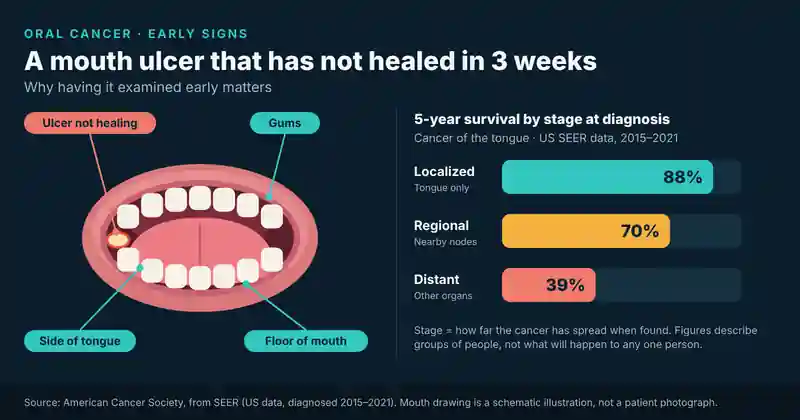
The American Cancer Society reports 5-year relative survival (survival compared with people without the cancer) from US SEER data for people diagnosed in 2015-2021.[6]
| Stage at diagnosis | Cancer of the tongue | Cancer of the floor of the mouth |
|---|---|---|
| Localized (confined to where it began) | 88% | 72% |
| Regional (spread to nearby lymph nodes) | 70% | 43% |
| Distant (spread to other organs) | 39% | 22% |
These are US figures for groups of people, and they cannot predict what will happen to any one person.
Screening has also been studied in India. In a randomised trial in Kerala, trained health workers examined the mouths of people aged 35 and over every three years. After 15 years, the 12% lower oral cancer death rate in everyone offered screening was not statistically significant. Among tobacco and/or alcohol users it was 24% lower (95% CI 3-40%).[7] A Cochrane review found this was the only eligible randomised trial and rated it at high risk of bias, so the evidence is limited.[8] If you use tobacco, areca nut or alcohol, a regular mouth examination by a trained doctor or dentist is reasonable. It does not replace stopping them.
What you can do
Frequently asked questions
Is every ulcer that lasts more than three weeks cancer?
No. Many have other causes, such as injury from a sharp tooth or an infection. An examination, and sometimes a biopsy, is how you find out.
Which doctor should I see?
A dentist, ENT surgeon, or head and neck or surgical oncologist can examine the mouth.
How is oral cancer confirmed?
By a biopsy. Scans such as CT or MRI show whether it has spread.
Can oral cancer be treated?
Treatment is possible and may include surgery, radiotherapy and chemotherapy, depending on the stage. Outcomes are better when it is found early, and there is no guarantee for any individual.
Is supari or paan masala without tobacco safe?
WHO lists areca nut (betel quid) use among the leading causes of oral cancer and recommends stopping chewing areca nut.[3]
Related Video
A general Hindi-language overview of early warning signs of cancer by Dr. Kaushal Yadav, including a mouth sore that does not heal. It is general health education and not personal medical advice. Please speak to your own doctor if you notice any of these signs.
Related reading
About the author
Dr. Kaushal Yadav, MS, MCh (Surgical Oncology), Director, Surgical Oncology, Max Hospital, Gurgaon.
Arogyam Care Clinic, G-21/22 Ocus Quantum Mall, Sector 51, Gurugram. Phone: 9911168762.
This article is for education only. It is not personal medical advice and does not replace a consultation with your own doctor.
References
- NHS. Mouth cancer: symptoms. https://www.nhs.uk/conditions/mouth-cancer/symptoms/
- FDI World Dental Federation. Oral potentially malignant disorders and oral cancer fact sheet (2025). https://www.fdiworldental.org/sites/default/files/2025-04/FDI-Oral-Potentially-Malignant-Disorders-and-Oral-Cance-Fact-Sheet.pdf
- World Health Organization. Oral health fact sheet. https://www.who.int/news-room/fact-sheets/detail/oral-health
- IARC. GLOBOCAN India fact sheet (lip, oral cavity). https://gco.iarc.who.int/media/globocan/factsheets/populations/356-india-fact-sheet.pdf
- Oral cancer burden and mortality in India: a GLOBOCAN 2022 analysis with regional comparison. ecancermedicalscience, article 2162. https://ecancer.org/en/journal/article/2162-oral-cancer-burden-and-mortality-in-india-a-globocan-2022-analysis-with-regional-comparison
- American Cancer Society. Survival rates for oral cavity and oropharyngeal cancer (SEER 2015-2021). https://www.cancer.org/cancer/oral-cavity-and-oropharyngeal-cancer/detection-diagnosis-staging/survival-rates.html
- Sankaranarayanan R, Ramadas K, Thara S, et al. Long term effect of visual screening on oral cancer incidence and mortality in a randomized trial in Kerala, India. Oral Oncol. 2013;49(4):314-321. https://doi.org/10.1016/j.oraloncology.2012.11.004
- Brocklehurst P, Kujan O, O’Malley LA, et al. Screening programmes for the early detection and prevention of oral cancer. Cochrane Database Syst Rev. 2013;(11):CD004150. https://doi.org/10.1002/14651858.CD004150.pub4
- NCCN Clinical Practice Guidelines in Oncology: Head and Neck Cancers. https://www.nccn.org/guidelines/category_1
Discover more from CancerSurgery
Subscribe to get the latest posts sent to your email.