By Dr. Kaushal Yadav, MS, MCh (Surgical Oncology), Surgical Oncologist, Gurugram · Last reviewed 19 October 2026 · Education only
Key takeaways
- No human trial has shown that intermittent fasting prevents cancer. The idea rests on laboratory biology and indirect data.
- Autophagy, the cell’s recycling system, is real and won a Nobel Prize in 2016. But it never switches off, and the popular “starts after 16 hours” figure was not measured in people.
- A 2026 Cochrane review of 22 trials found intermittent fasting did about as well as ordinary diet advice for weight loss. It is a weight-loss review, not a cancer review.
- In people, the more consistent signal is about timing. A late last meal has been linked with higher breast and prostate cancer risk, and skipping breakfast with gallstones and some gastrointestinal (GI) cancers. These are associations, not proof of cause.
- A practical middle path: finish dinner early, eat breakfast, and keep the overnight gap at about 12–14 hours.
Two messages, one question
One message says: eat a balanced, nutritious diet, because it keeps your body and your immunity strong. The other says: do not eat for 16 hours, because fasting “starves” cancer. Both cannot be the whole story. So what does the evidence actually support?
भूखे रहने से cancer रुकता है, या यह सिर्फ़ सुनने में अच्छा एक दावा है? आइए देखते हैं studies असल में क्या कहती हैं।
What is autophagy?
“Autophagy” means “self-eating”. Every cell produces waste: worn-out proteins and damaged mitochondria (the cell’s power units). Autophagy is the cell’s recycling team. It breaks that waste down and reuses the parts. Yoshinori Ohsumi received the 2016 Nobel Prize in Physiology or Medicine for working out how it works, in yeast.[1]
The idea behind the fasting trend is simple. When food is scarce, the recycling team works harder, damaged cells get cleaned up, and cancer becomes less likely. It is a reasonable idea. The question is whether it holds up in people.
Three cracks in “fasting switches on autophagy and stops cancer”
1. The “16-hour clock” did not come from human trials. Ohsumi’s work was in yeast. Figures such as “autophagy starts at 16 hours and peaks at 24” are extrapolated from animal and cell studies and indirect markers. Nobody has timed them in humans.
2. Autophagy is a dimmer, not a switch. It runs all the time, in every cell. It can be turned up or down but not off. And fasting is not the only dial: exercise also raises autophagy in muscle, shown in mice, with human data still limited.[2] A small rise in autophagy does not by itself mean cancer risk falls.
3. Cochrane 2026: no “metabolic magic”. Cochrane, an independent organisation that reviews research evidence, published a review in February 2026. It pooled 22 randomised trials with 1,995 adults who had overweight or obesity.[3]
- Compared with regular diet advice, fasting made little to no difference to weight loss (−0.33 percentage points of starting weight, 95% CI −0.92 to 0.26), to quality of life, or to the chance of losing 5% of body weight.
- Compared with doing nothing, fasting groups lost about 3.4 percentage points more of their starting weight (95% CI 1.9 to 5.0). The review authors summarise this as “little to no difference”.
- Most outcomes were graded low or very low certainty, and the trials ran for up to 12 months.
This is a weight-loss review, not a cancer study, so it cannot tell us whether fasting prevents cancer. What it does suggest is that fasting performs much like other ways of eating less, not better than them.
Autophagy cuts both ways in cancer
Early on, before a tumour forms and while cells are collecting damage, autophagy helps protect them. Once a cancer is established, the same recycling can help tumour cells survive starvation and chemotherapy.[4] That is why researchers are testing autophagy-blocking drugs alongside chemotherapy. In one randomised phase II trial of 64 patients with pancreatic cancer, adding hydroxychloroquine (a drug that blocks autophagy) to pre-operative chemotherapy gave a better tumour response under the microscope. Overall survival and relapse-free survival did not differ.[5] This is still investigational, not standard care. It shows that prevention and treatment are separate questions, and that autophagy is not simply “anti-cancer”.
What human studies say about meal timing
| Question | What the evidence shows | Strength |
|---|---|---|
| Does intermittent fasting prevent cancer in humans? | No trial has tested it. | None yet |
| Is fasting better than ordinary diet advice for weight loss? | Cochrane 2026, 22 trials: no meaningful advantage; mostly low-certainty evidence.[3] | Moderate (weight, not cancer) |
| Does a 16:8 pattern that skips breakfast beat three regular meals? | TREAT trial, 116 adults, 12 weeks, eating noon to 8 pm: no extra weight loss, and a greater fall in lean-mass index in a 50-person in-person subgroup.[6] | Moderate (weight, not cancer) |
| Is a late last meal linked to cancer? | French cohort, 41,389 adults and 1,732 cancers: last meal after 9:30 pm was linked to breast cancer (HR 1.48, 1.02–2.17) and prostate cancer (HR 2.20, 1.28–3.78). Length of overnight fast and time of first meal were not linked.[7] Spanish case-control study: sleeping 2 or more hours after supper was linked to lower combined breast and prostate cancer risk (OR 0.80, 0.67–0.96).[8] | Weak to moderate (observational; same direction in two studies) |
| Does an early eating window do better than a mid-day window? | Randomised trial, 82 healthy adults without obesity, 5 weeks: the early window improved insulin sensitivity, fasting glucose, body fat and inflammation; the mid-day window did not.[9] | Moderate for metabolic markers; no cancer outcome |
| Is skipping breakfast linked to GI cancers? | Chinese Kailuan cohort, 62,746 adults, 369 GI cancers over about 5.6 years: people who never ate breakfast had higher rates of colorectal (HR 2.32), liver (HR 2.41) and oesophageal (HR 2.72) cancer, with wide uncertainty.[10] | Weak (observational) |
| Is a later first meal linked to gallstones? | US national survey, 6,547 adults: gallstones were more common with later first meals, highest when the first meal fell between 9 am and 2 pm (OR 1.49); no further rise after about 1:30 pm.[11] | Weak (cross-sectional) |
Strength key: Strong = consistent randomised trials or meta-analyses with a cancer outcome. Moderate = randomised evidence, but for weight or metabolic outcomes. Weak = observational or one-time surveys.
How to read this. Every cancer finding above is observational: it shows association, not cause. People who eat late or skip breakfast may also differ in sleep, shift work, smoking, alcohol and income. In the Spanish study the result for breast cancer alone was not statistically significant (OR 0.84, 0.67–1.06). In that study, supper before 9 pm (compared with after 10 pm) showed a similar lower risk. Treat these as signals, not proof.
One pattern stands out. In the French cohort, what predicted risk was the time of the last meal, not the total hours of fasting. And in the one randomised trial comparing windows, the early window did better on metabolic markers. Fasting की लंबाई नहीं, उसका समय मायने रखता है। लेकिन यह अभी एक संकेत है, पक्का सबूत नहीं।
Skipping breakfast, bile and the gallbladder
The gallbladder stores bile and squeezes it out when you eat. A long stretch without a meal means bile sits longer. The hypothesis is: skipping breakfast → longer bile stasis → gallstones. Gallstones are a recognised risk factor for gallbladder cancer. The Kailuan cohort also reported higher rates of gallbladder and bile-duct cancer in people who never ate breakfast, but from very few cases and with very wide uncertainty.[10] This chain is plausible, but it is unproven for breakfast skipping. If you have gallstones or biliary symptoms, avoid long gaps without medical advice.
Read more: Gallbladder cancer: causes and prevention
What is the 16:8 window, and why does it matter?
“16:8” is a time-restricted eating pattern. You fast for 16 hours and eat all your meals inside an 8-hour window, every day, with only calorie-free drinks during the fast. In the TREAT trial, for example, people ate from 12 noon to 8 pm and took no calories from 8 pm until noon the next day.[6]
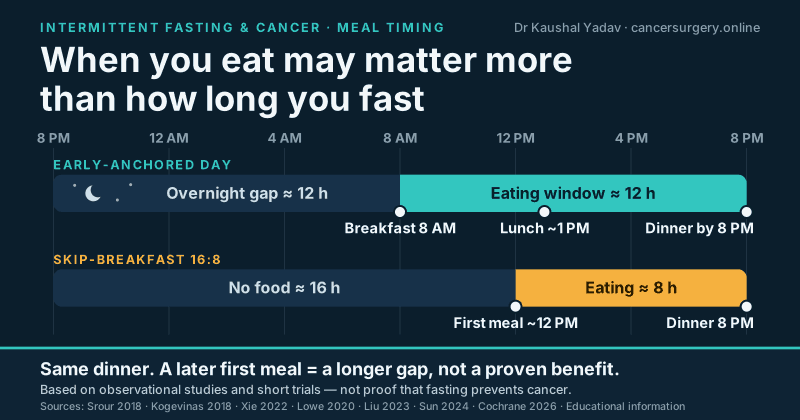
The label tells you how long you fast, not when. The same “16:8” can describe very different days:
- Early window (for example 8 am to 4 pm): breakfast included, dinner early.
- Mid-day window (for example 12 noon to 8 pm): no breakfast, dinner at 8 pm. This is the schedule TREAT tested.
- Late window (for example 2 pm to 10 pm): no breakfast and a late last meal.
Why the position of the window matters: the studies above point to timing, not to the number of hours.
- Last meal: in the French cohort, the risk signal was tied to a last meal after 9:30 pm, not to the length of the overnight fast.[7]
- First meal: skipping breakfast has been linked, in observational studies, with gallstones and some GI cancers.[10][11]
- Head to head: in the one randomised trial that compared an early window with a mid-day window, the early one did better on insulin sensitivity, fasting glucose, body fat and inflammation. That was a 5-week trial in healthy adults, so it says nothing yet about cancer.[9]
- The mid-day version: it gave no extra weight loss compared with three regular meals, and lean (muscle) mass fell more in the in-person subgroup.[6]
So two people can both say they are “doing 16:8” and carry quite different exposures. A 16-hour gap has not been shown to be better than 12–14 hours for cancer prevention. If you do choose a time-restricted pattern, the limited evidence favours an early window over a late one, and the safety list below still applies.
What to do: a practical pattern that costs nothing
- Dinner: finish by about 8 pm, and at least 2 hours before sleep.
- Breakfast: have it, ideally within an hour or two of waking, with some protein (eggs, dal, paneer, curd or sprouts).
- Overnight gap: about 12–14 hours. Dinner at 8 pm and breakfast at 8 am is already 12 hours.
- Want a longer gap? Move dinner earlier. Do not push breakfast later.
- Dinner: avoid making it your largest, latest meal.
- Protect your muscle: include protein at every meal and do some strength training.
| Your routine | Suggested overnight gap |
|---|---|
| Mostly seated | About 12 hours, plus strength training |
| Moderately active | 12–14 hours |
| Regularly active, including strength training | Up to about 14 hours if you feel well |
| Age 60+ or frail | About 12 hours; do not shorten the eating window; keep protein adequate |
The 12–14 hour range is a practical suggestion drawn from the observational data and trials above. No trial has tested an ideal duration for cancer prevention.
Who should not try fasting without medical advice
Pregnancy and breastfeeding; diabetes treated with insulin or other glucose-lowering medicines; a history of an eating disorder; being underweight; teenagers; frail older adults; gallstones or other gallbladder disease; active acid reflux or peptic ulcer; and anyone having cancer treatment (check with your oncology team first).
What actually lowers cancer risk
WHO estimates that around 38% of cancers could currently be prevented by avoiding risk factors and applying existing prevention strategies.[12] In practice that means staying tobacco-free, limiting alcohol, keeping a healthy weight, being physically active, eating plenty of fruit and vegetables, getting vaccinated against HPV and hepatitis B where recommended, and joining age-appropriate screening. Fasting cannot replace any of these.
The bottom line
भूखे रहने की लंबाई से ज़्यादा ज़रूरी है: समय पर और ढंग से खाना।
Dinner at 8, breakfast at 8, and sleep on time. That is already a 12-hour overnight gap. So where is the “fasting”? You do not need to go hungry. You need to eat at sensible times.
Frequently asked questions
Does intermittent fasting prevent cancer?
No human trial has shown that it does. The idea rests on laboratory and animal biology, indirect data and observational studies of meal timing. A 2026 Cochrane review found fasting no better than ordinary diet advice for weight loss, and it was not a cancer review.
Does 16 hours of fasting trigger autophagy?
Autophagy runs all the time and rises with fasting, but the “16-hour” figure comes from extrapolating animal and cell studies. It has not been precisely measured in humans, and it is a dimmer, not a switch.
Is skipping breakfast linked to cancer?
Some large observational studies link habitually skipping breakfast with higher rates of certain GI cancers, but they show association, not cause. The main cohort study followed people for about 5.6 years and recorded 369 GI cancers.
What time should I eat dinner?
Observational data favour finishing dinner by about 8–9 pm and at least 2 hours before sleep. Late last meals (after 9:30 pm) were linked with higher breast and prostate cancer rates in a French cohort.
How many hours should I leave between dinner and breakfast?
About 12–14 hours is a practical range. Extend the gap by eating dinner earlier, not by delaying breakfast.
Is intermittent fasting safe during cancer treatment?
Not without your oncology team’s advice. Treatment often reduces appetite, weight and muscle, so any fasting plan should be agreed with your oncologist and a dietitian first.
Related Video
Dr. Kaushal Yadav discusses this topic in Hindi/Hinglish: Intermittent Fasting से Cancer Risk कम होता है? Autophagy का सच. The video is general health education and not personal medical advice. Please speak to your own doctor or oncology team before changing how you eat, especially during cancer treatment.
Related reading
About the author
Dr. Kaushal Yadav, MS, MCh (Surgical Oncology), Surgical Oncologist.
Arogyam Care Clinic, G-21/22 Ocus Quantum Mall, Sector 51, Gurugram. Phone: 9911168762.
This article is for education only. It is not personal medical advice and does not replace a consultation with your own doctor.
References
Bibliographic details for items 2–11 were retrieved from PubMed.
- Nobel Prize in Physiology or Medicine 2016, Yoshinori Ohsumi (autophagy). nobelprize.org
- He C, Bassik MC, Moresi V, et al. Exercise-induced BCL2-regulated autophagy is required for muscle glucose homeostasis. Nature. 2012. doi:10.1038/nature10758 (mouse study)
- Garegnani LI, et al. Intermittent fasting for adults with overweight or obesity. Cochrane Database Syst Rev. 2026 (published 16 Feb). doi:10.1002/14651858.CD015610.pub2
- Vitto VAM, Bianchin S, Zolondick AA, et al. Molecular mechanisms of autophagy in cancer development, progression, and therapy. Biomedicines. 2022. doi:10.3390/biomedicines10071596
- Zeh HJ, Bahary N, Boone BA, et al. A randomized phase II preoperative study of autophagy inhibition with high-dose hydroxychloroquine and gemcitabine/nab-paclitaxel in pancreatic cancer patients. Clin Cancer Res. 2020. doi:10.1158/1078-0432.CCR-19-4042
- Lowe DA, Wu N, Rohdin-Bibby L, et al. Effects of time-restricted eating on weight loss and other metabolic parameters in women and men with overweight and obesity: the TREAT randomized clinical trial. JAMA Intern Med. 2020. doi:10.1001/jamainternmed.2020.4153
- Srour B, Plancoulaine S, Andreeva VA, et al. Circadian nutritional behaviours and cancer risk: new insights from the NutriNet-Santé prospective cohort study. Int J Cancer. 2018. doi:10.1002/ijc.31584
- Kogevinas M, Espinosa A, Castelló A, et al. Effect of mistimed eating patterns on breast and prostate cancer risk (MCC-Spain Study). Int J Cancer. 2018. doi:10.1002/ijc.31649
- Xie Z, Sun Y, Ye Y, et al. Randomized controlled trial for time-restricted eating in healthy volunteers without obesity. Nat Commun. 2022. doi:10.1038/s41467-022-28662-5
- Liu et al. Habitually skipping breakfast is associated with the risk of gastrointestinal cancers: evidence from the Kailuan cohort study. J Gen Intern Med. 2023. doi:10.1007/s11606-023-08094-7
- Sun et al. Non-linear relationship between the first meal time of the day and gallstone incidence in American adults: a population-based cross-sectional study. Front Nutr. 2024. doi:10.3389/fnut.2024.1521707
- World Health Organization. Cancer fact sheet (risk factors and prevention). who.int
Discover more from CancerSurgery
Subscribe to get the latest posts sent to your email.